
How to Think Biologically About Mental Health

Prefer to watch? This video is the full talk this article introduces.
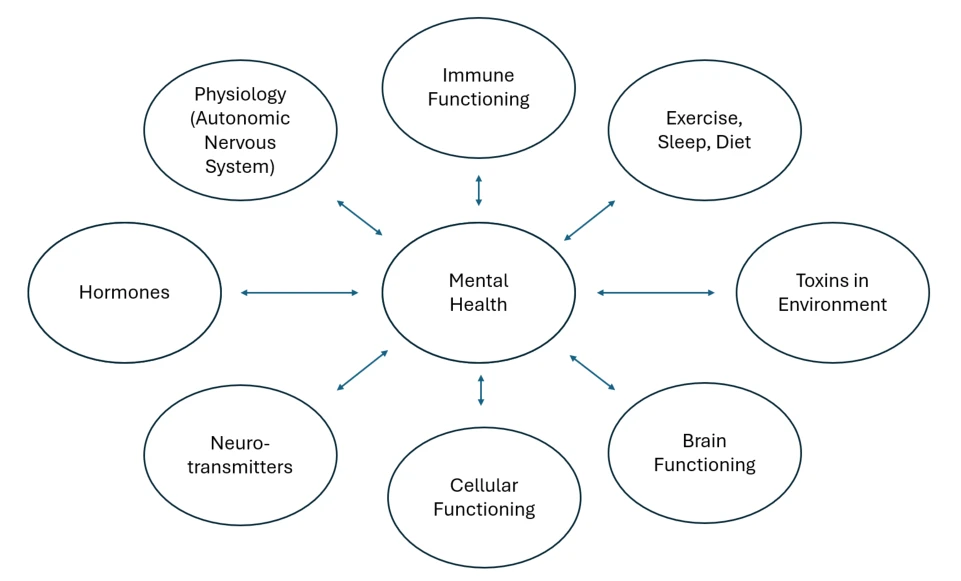
This is the introduction to a talk I gave for my master's on biological tools for improving mental health. The idea is essentially the foundation of everything I do at Hamilton Neurofeedback.
To understand how biology impacts mental health, start with the commonly known relationship between cortisol and anxiety.
In simple terms, cortisol is the body's stress hormone. When your cortisol goes up, you experience anxiety. However, in a cruel twist, when you experience anxiety, your cortisol spikes.
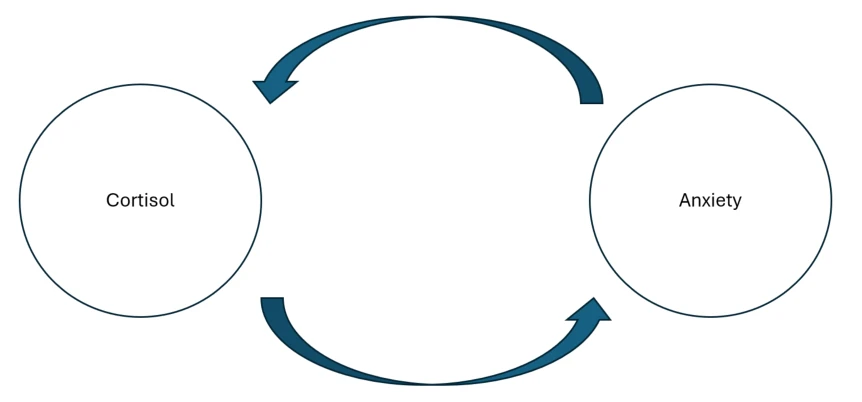
Cortisol and anxiety form a feedback loop: more cortisol raises anxiety, and more anxiety raises cortisol.
This is a classic feedback loop. More anxiety means more cortisol, which means more anxiety, which means more cortisol, until you're exhausted, burnt out, and struggling to function.
There are many treatments for anxiety. Most people's instinct is to approach the problem psychologically by going to therapy. CBT is widely known to reduce anxiety, and it is a valid and effective option.
But what about the rest of that feedback loop? The same loop that can make things worse can make things better. If you give someone the cortisol-lowering supplement ashwagandha, their anxiety improves. That is also a valid and effective option.
This relationship, the fact that lowering cortisol also lowers anxiety without ever talking about it, contains the essence of thinking biologically instead of psychologically about mental health. By changing a biological process in the body, your psychological experience changes.
Now replace cortisol with hormones, and anxiety with mental health. This is a more accurate representation, because many different hormones besides cortisol affect more than just our level of anxiety. Like before, it's a feedback loop (here represented by a single, double-sided arrow): our psychological interpretation of the events in our lives affects our hormonal responses. For example, believing stress is helpful versus hurtful affects stress hormone release.
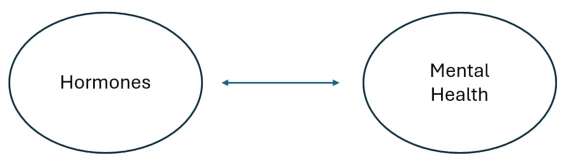
Hormones and mental health influence each other in both directions.
But hormones aren't the only biological process our mental health is in a feedback loop with. Health behaviours like exercise, sleep and diet, the presence or absence of neurotransmitters, and even our immune system affect and are affected by our mental health. A more realistic, if still simplified, diagram is the one at the top of this post: mental health in a feedback loop with hormones, physiology, immune functioning, exercise, sleep and diet, neurotransmitters, brain and cellular functioning, and toxins in the environment.
One interpretation of this is, "I have to think of all that to get over my anxiety? That's anxiety-provoking." I look at it differently: that's many options to improve someone's mental health. In my experience, treating only two or three of these bubbles can create profound changes in mental health over and above psychotherapy alone. Clients have been getting better results faster since I added Vielight to the Hamilton Neurofeedback toolkit. This doesn't mean "don't do psychotherapy." It means there are other tools, biological tools, which complement psychotherapy.
Each part of your biology is in relationship not just with your mental health, but with all the other parts of your biology. So a true representation of the biology of mental health would look more like this diagram depicting obesity: every node connected to many others.
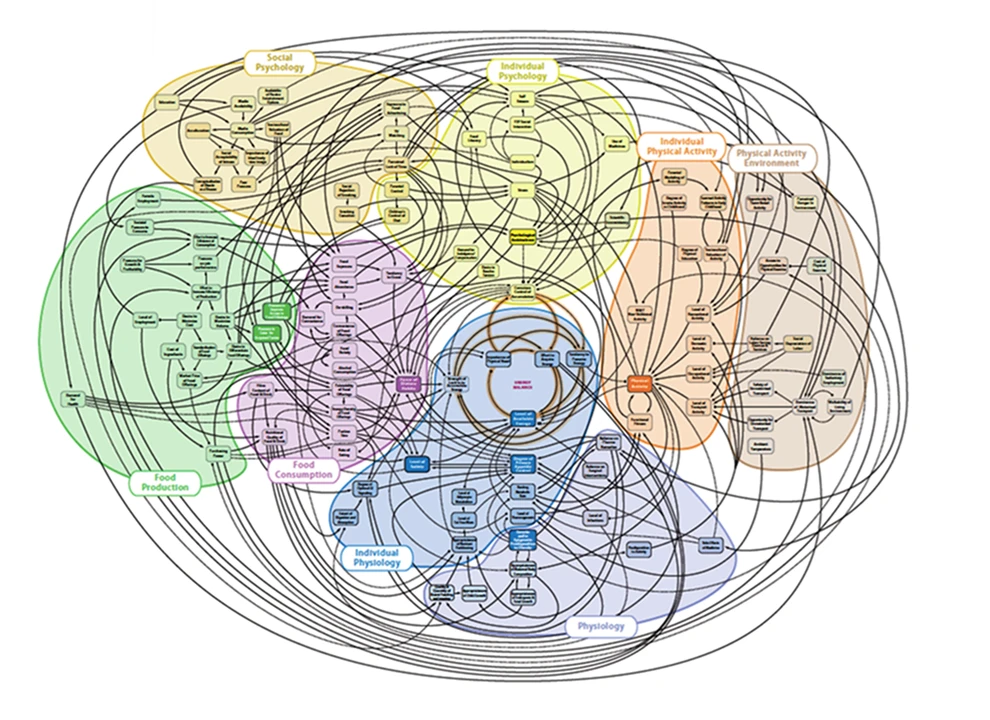
A systems map of obesity: dozens of connected factors across psychology, physiology, food and activity.
As with anything complex (an ecosystem, an economy, an organization), changes to one area have cascading and compounding effects on every other part of the system.
This is why treatments like neurofeedback and Vielight work to treat mental health: mental health is more than psychological, it's also biological.