
Effort Versus Results
“One of the things I learned as a Marine early on was the old rule of thumb that you need three times as much force to take a position as you need to defend it.” – Matt Pottinger, Tim Ferriss Show #736
I’m not one for military strategy, but hearing this a few years ago was a lightbulb moment for me.
See, this rule applies to any form of progress in life, and it has important consequences for how we think about effort versus results over time. Let me explain:
This rule applies to physical skills, even basic ones like learning to walk. It takes a huge amount of force (effort) to ‘take the position’ of learning to walk. The math from one infant study works out to 14,000 steps and 100 falls per day. That’s more steps than most of us take daily, and 10,000 falls in 100 days. Immense effort to build, practically zero effort to maintain – when was the last time you tried to walk?
This rule applies to investing. It takes tremendous discipline and frugality to save your first thousand, or hundred-thousand dollars. But because of compounding (i.e., your money working for you once you’ve invested it), one hundred-thousand dollars invested is functionally a quarter of the way to a million in terms of timeline (see below for a visualization of this). Again, high effort to develop the habits that build the nest egg, but relatively little effort to maintain the habits or grow the nest egg.
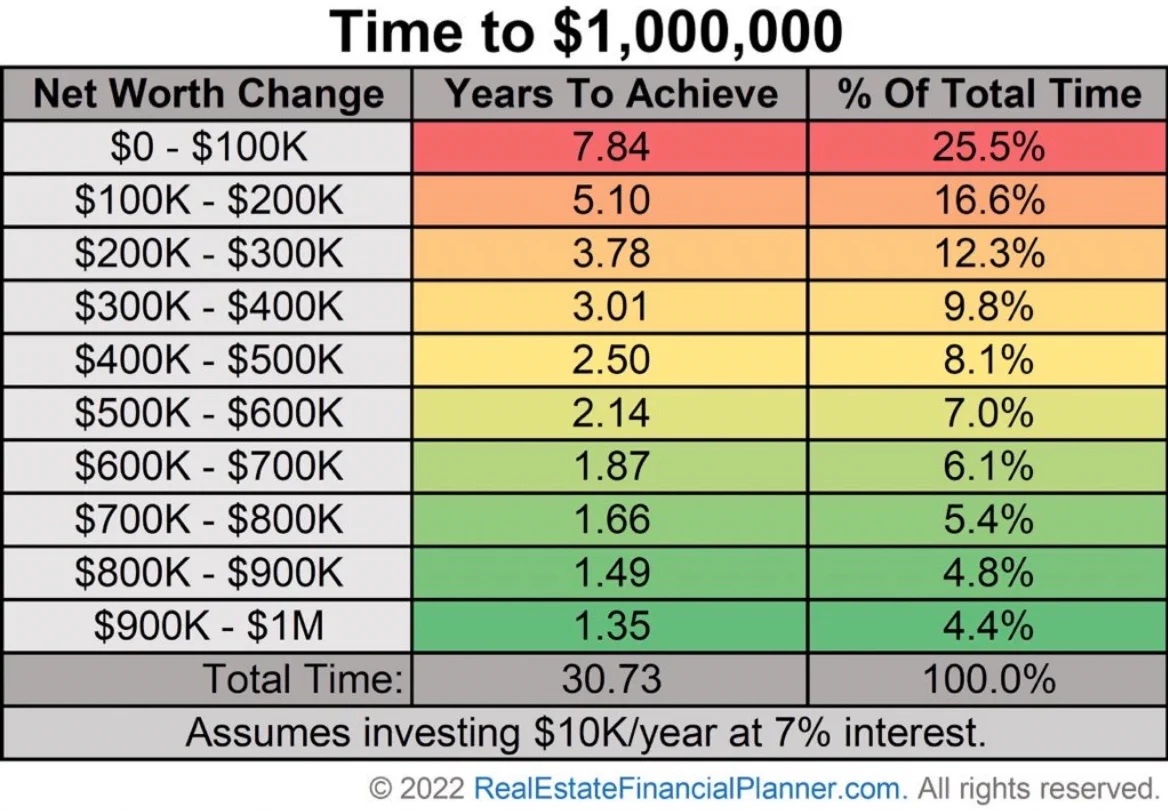
Visualizing Investment Momentum
Lastly, this applies to health and fitness. It takes a ton of effort to put muscle on your frame. After something like 3 hours per week for 52 weeks a year (156 hours total), you might have earned 5-15lbs of muscle. But, in one study, it took a ninth as much effort to maintain those gains, the equivalent of 20 minutes per week or 17 hours 20 minutes per year. Again, initial progress takes an absurdly disproportionate amount of work compared with maintenance, which takes close to nothing.
Here’s how to visualize it:
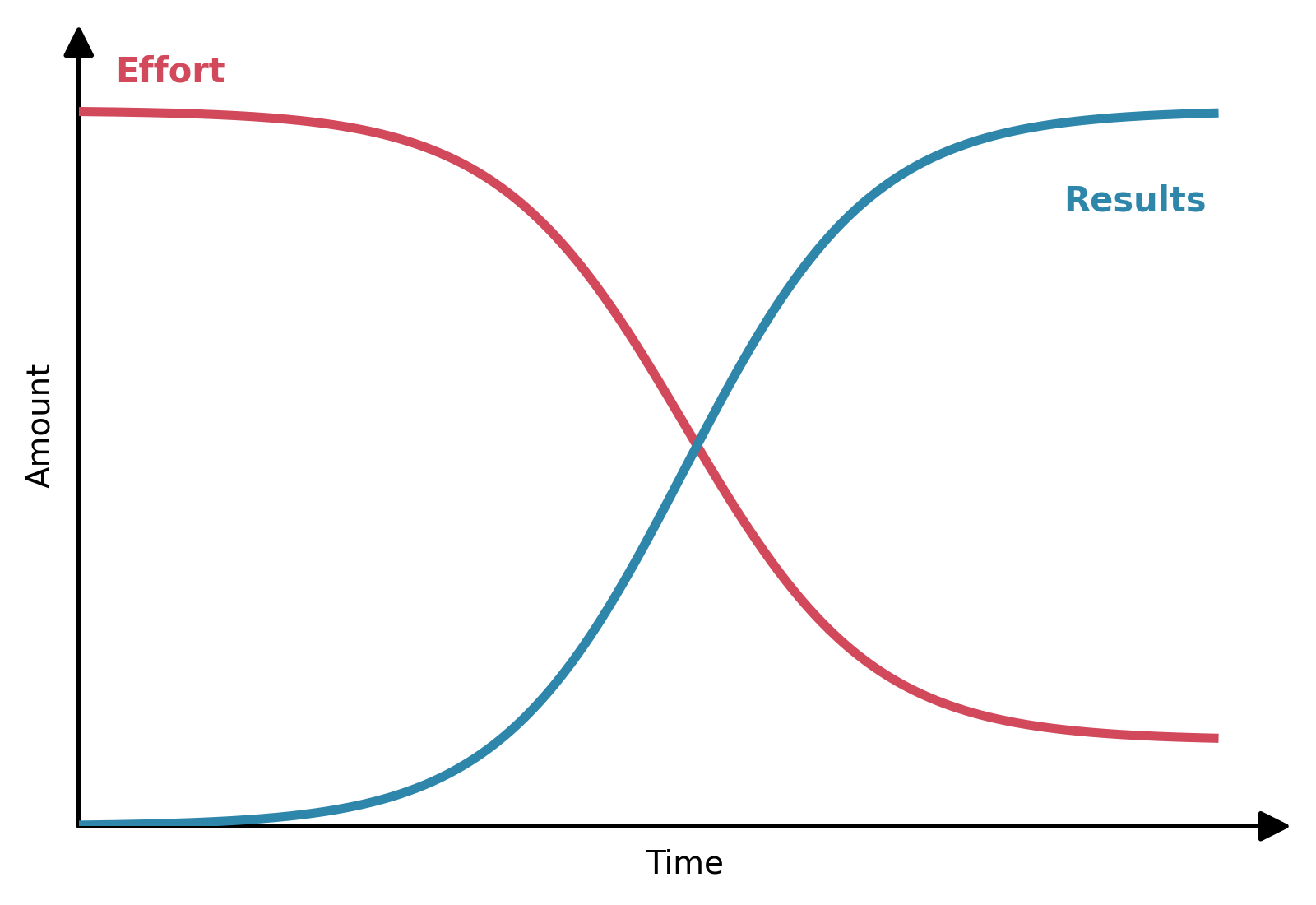
Visualizing Effort Versus Results
Now, although this is an interesting and useful idea on its own – with some practical takeaways I’ll discuss at the end – the juicy bit is that this applies to mental health and psychological skillfulness too.
If you’ve done an intake call with me and asked, “How long until I see results?” or “How long do results last?”, you’ll undoubtedly have heard me say “Neurofeedback is like learning a skill.” Therapy, too, is like a skill. As with any other skill, results will take some time to show up, but after a sufficient amount of effort or investment, they won’t really go away.
Research on neurofeedback supports this idea. One meta-analysis of neurofeedback for ADHD showed attentional gains improved over the following months after stopping sessions. One study on epilepsy showed people still had significantly fewer seizures at 10-year follow-up without any additional sessions. Given the right feedback and training, it seems a brain can remember how to pay attention or not have a seizure in the same way it never forgets how to ride a bike.
There are similar findings in therapy research. A meta-analysis of studies on depression showed patients who did Cognitive Behavioural Therapy and then stopped were significantly less likely to relapse than patients who took medication and then stopped. You may start with weekly sessions and feel like nothing is changing, but by sticking with it, you gain skills that could last a lifetime.
Like the toddler who used to fall 100 times a day, you can get to the point where you can’t remember the last time you fell. For mental health, neurofeedback and therapy can help get you there.
Some takeaways:
Think about starting anything new as an investment. Friction and failure are, counterintuitively, the sign that it’s working. In this way, "Nothing is happening," means “Something is happening.”
It will feel hard. Then it won’t. We often imagine that the difficulty of starting never ends. We picture the pain of every visit to the gym feeling as hard as day one does. But showing up becomes a habit, and habits have a momentum of their own. There comes an inflection point where effort stops feeling hard and starts feeling natural, and where you’ve started seeing enough results to be motivating, making effort even easier.
Once you've taken a position, defense is cheap. Eventually, it takes a once-unthinkably small amount of effort to maintain your results. Effort builds a foundation you can coast on. Self-improvement becomes self-improved.
You may not be a military strategist, but you are the strategist of your own life. Plan accordingly.